TikTok has become one of the most important paid media channels for consumer brands, and increasingly for apps, services and even B2B companies. It reaches huge audiences who spend a long time in the app, and its ad platform has matured into a full performance system with automated bidding, broad targeting and measurement tools that stand alongside Meta and Google.
It is also a channel that punishes advertisers who treat it like any other. Ads that look like television spots or polished social banners are scrolled past in under a second. Accounts structured the way they would be on other platforms often starve the algorithm of data. This guide explains how TikTok advertising works from end to end and links to a deeper guide for every stage, so you can build a programme that works on TikTok's terms.

How TikTok Advertising Works
TikTok ads are bought mainly through TikTok Ads Manager, a self-serve platform where you build campaigns, choose audiences, set budgets and bids, upload creative and read results. Behind it is an auction: every time a user scrolls to an ad slot, TikTok picks which ad to show based on each advertiser's bid, the predicted likelihood that the user will take the action the advertiser wants and the predicted quality of the ad experience.
That last part matters. TikTok does not simply sell slots to the highest bidder. An ad that people watch, engage with and act on will win more auctions at lower cost than an ad people skip. On TikTok, creative quality is not a separate concern from media buying. It is the biggest lever on what you pay.
Some formats, such as premium placements at app open or reserved reach campaigns, are bought differently, through fixed pricing or a sales team. Most advertisers start and stay in the auction.
Before You Spend: Account Foundations
A few foundations need to be in place before the first campaign:
- A brand-owned Business Center and ad account. Our guide to Business Center and Ads Manager setup walks through ownership, members, billing and agency access.
- Conversion tracking. If you sell on a website or collect leads, the TikTok pixel and the Events API need to be installed and tested. Our guide to website ads and the TikTok pixel covers this.
- A TikTok account for your brand. Ads can run without one, but a real profile with organic content gives people somewhere to go when they tap your name and makes your ads more credible.
- A clear view of your economics. Know your margin, your average order value and the cost per acquisition you can afford before you set a single bid.
Choosing Formats
The core of TikTok advertising is the in-feed ad: a full-screen vertical video that appears between organic videos in the For You feed. Around it sit other formats, including Spark Ads that promote existing organic posts, carousel ads made from images, premium takeover placements, interactive add-ons and branded effects. Each has a job. Our guide to TikTok ad formats explains what each one is and when to use it, and our Spark Ads guide covers the format most brands lean on.
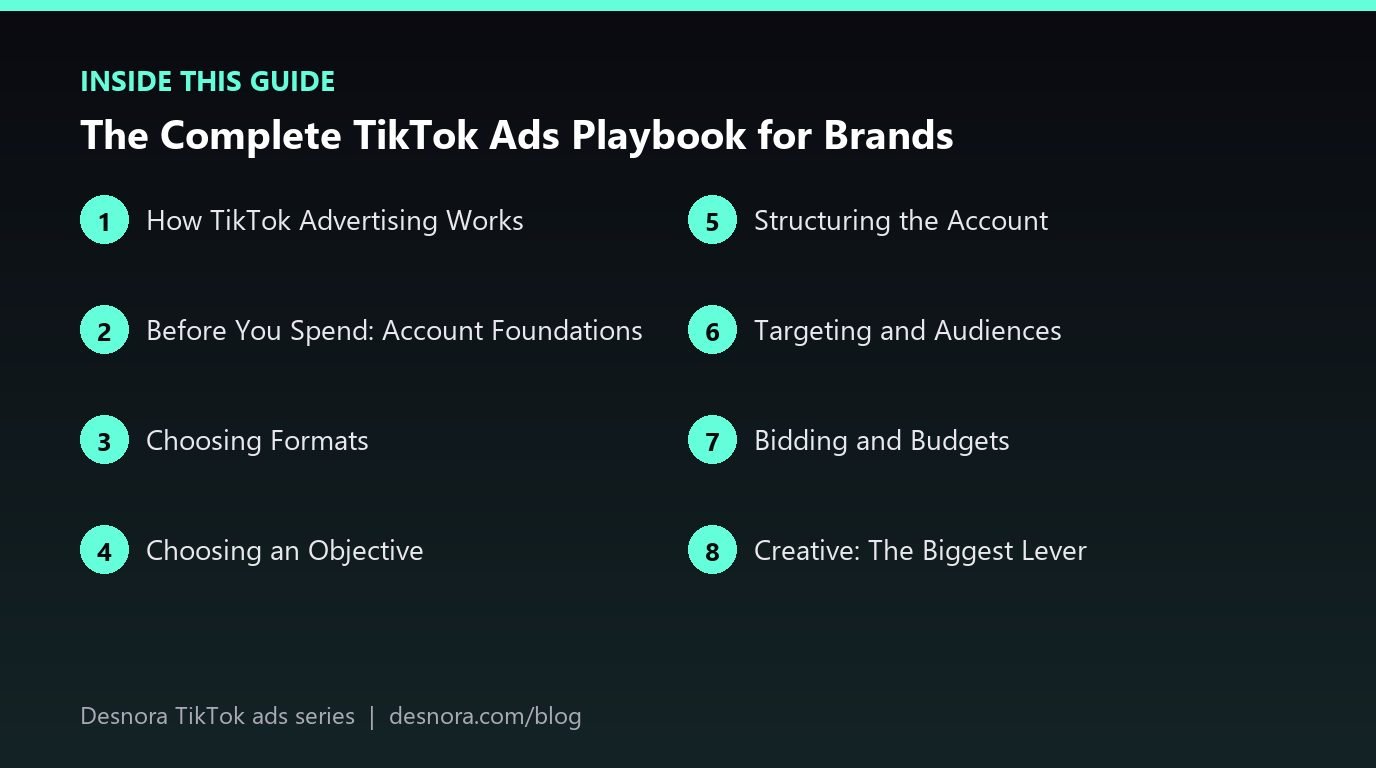
Choosing an Objective
Every campaign starts with an objective, and the objective tells TikTok's delivery system who to find. Choose reach and TikTok finds the most people at the lowest cost. Choose conversions and it finds the people most likely to buy, which costs more per impression but much less per sale. Picking the wrong objective is one of the most common reasons campaigns underperform. Our guide to campaign objectives matches common business goals to the right choice.
Structuring the Account
TikTok campaigns have three levels: campaigns, ad groups and ads. Budgets, audiences, placements and bids live at different levels, and the way you divide spend between them decides how much data each part of the account gets. Most accounts perform better with fewer, larger ad groups than with many small ones. Our guide to account structure covers consolidation, naming and when to split.
Targeting and Audiences
TikTok offers demographic, interest, behaviour, device and location targeting, plus custom audiences built from your own data and lookalike audiences built from those. Increasingly, though, the strongest results come from broad targeting that lets the algorithm find buyers using creative and conversion signals. The skill is knowing when to constrain and when to let go. See our guides to targeting and custom and lookalike audiences.
Bidding and Budgets
You tell TikTok how much you are willing to pay through a bid strategy. Maximum delivery spends your budget while getting as many results as possible. Cost cap and bid cap add a limit. Value-based options optimise for revenue rather than conversions. Our guide to bidding strategies explains each. For how much to spend overall, our TikTok Shop guide to ads budgets applies to most advertisers, not just shop sellers.
TikTok also offers automated campaign types that bundle targeting, bidding and creative selection. Our guide to Smart+ campaigns explains when automation helps and when it hides problems.
Creative: The Biggest Lever
On TikTok, creative does the targeting. The opening seconds decide who keeps watching, and who keeps watching decides who the algorithm shows your ad to next. Ads that feel like native TikTok content, filmed vertically, with real people, sound on and a fast start, consistently beat polished brand assets. Our guides cover creative best practices, ad text and CTA buttons and TikTok's built-in creative tools.
Because creative wears out fast on TikTok, the brands that win treat it as a pipeline, not a one-off. Our guides to creative testing and creative fatigue explain how to keep that pipeline full.
Campaign Types for Specific Goals
Beyond standard sales and traffic campaigns, TikTok supports specialised campaign types:
- Lead generation ads with instant forms that open inside TikTok.
- App install and app event campaigns for mobile apps.
- Reach and frequency campaigns for predictable brand awareness.
- Search ads that reach people searching inside TikTok.
- TikTok Shop ads and GMV Max for sellers using TikTok Shop.
- Retargeting campaigns for people who have already engaged.
Measurement
TikTok reports a wide range of metrics, from CPM and click-through rate to video watch time, cost per acquisition and return on ad spend. Knowing what each means, and how they connect, is what lets you diagnose a campaign rather than just react to it. Our guide to TikTok ads metrics explains each one. For attribution windows and reconciling platform numbers with real sales, see our guide to ads attribution, and for awareness campaigns, our guide to brand lift measurement.
Optimising and Scaling
Once campaigns are running, the work is a routine: checking delivery and spend daily, reviewing creative and audiences weekly, and stepping back monthly. Our optimisation routine sets out what to check and when. When something works, scaling it without breaking it requires patience. When something stops working, our troubleshooting guide works through the usual causes.
A Full-Funnel View
Most accounts start with conversion campaigns and stay there. That works up to a point, but eventually the pool of ready-to-buy people runs dry. A full-funnel strategy uses awareness and consideration campaigns to keep feeding that pool, with retargeting to bring warm audiences back.
Staying Compliant and Brand Safe
Every TikTok ad is reviewed before it runs, and some categories are restricted or banned. Rejected ads slow you down, and repeated violations can suspend an account. Our guide to advertising policies explains the rules, and our guide to placements and brand safety covers where your ads appear and how to control what they appear next to.
TikTok Ads for Different Kinds of Business
The fundamentals are the same for everyone, but the details change with the business. We have dedicated guides for B2B brands and local businesses, and a comparison of TikTok ads vs Meta ads for brands deciding where to put their next dollar. If you also work with creators, our guide to influencers vs paid ads explains how the two fit together.
A 30-Day Starting Plan
- Week 1: Set up Business Center, the ad account, billing and tracking. Verify that conversion events fire correctly with a test purchase or lead.
- Week 1: Produce or source at least six to ten native-style videos covering three or four different angles.
- Week 2: Launch one conversion campaign with one or two broad ad groups and all your creative, on maximum delivery, with a daily budget large enough to get meaningful results.
- Week 3: Pause clear losers, keep winners, and launch new variations of the best performing angles.
- Week 4: Add retargeting if volume allows, review cost per acquisition against your target and decide whether to scale, test bid caps or rework creative.
Avoid the common traps along the way. Our list of TikTok ads mistakes covers the ones that waste the most money.
When to Get Help
TikTok ads reward consistent creative production and disciplined testing more than clever tricks. Many brands can run them well in-house once the foundations are set. Others prefer a partner that brings creative capacity and experience across many accounts. If you sell on TikTok Shop or want help building a TikTok programme, see our TikTok Shop growth services or get in touch.
Frequently Asked Questions
How much does it cost to advertise on TikTok?
There is no fixed price. You set a budget and bid, and costs depend on your audience, objective, competition and above all how well your creative performs. TikTok sets minimum daily budgets at campaign and ad group level, which vary by market and currency, so check the current minimums in Ads Manager when you build your first campaign.
Do I need a TikTok account to run ads?
You can run some ads with only an ad account, using a display name and profile image. However, a real brand account is needed for Spark Ads and makes your ads more credible, because people who tap your name find a real profile with content.
How long does it take for TikTok ads to work?
Expect the first one to two weeks to be a learning period while the system gathers data and you find which creative works. Judge a campaign on several days of stable data, not on the first day, and give conversion campaigns enough budget to generate a meaningful number of conversions.
What is the most important factor in TikTok ad performance?
Creative. TikTok's delivery system rewards ads that people watch and act on, so strong creative lowers costs across every other part of the campaign. Targeting and bidding matter, but they cannot rescue an ad that people scroll past.
Are TikTok ads only for young audiences?
No. TikTok's audience has broadened well beyond teenagers and now includes large numbers of adults across age groups. Check TikTok's audience estimates for your market and targeting, and test before assuming your customers are not there.