Finding a profitable TikTok campaign is hard. Scaling it is harder. Most advertisers have experienced the frustration of doubling a budget on a winning campaign and watching costs rise and returns collapse. Scaling is not just spending more. It is finding more customers at an acceptable cost, and that requires a deliberate approach.
This guide explains when to scale, the main ways to do it and how to know when you have reached the limit of what a campaign, or a channel, can efficiently deliver.

Is the Campaign Ready to Scale?
Scale campaigns that show stable, proven performance, not a lucky few days. Signs of readiness:
- CPA or ROAS at or better than target over at least one to two weeks.
- The ad group has exited learning and delivers consistently.
- Results come from more than one ad, so you are not relying on a single creative.
- Tracking is reliable and platform results match real sales trends.
- The business can handle more orders: stock, fulfilment and customer service.
Why Scaling Raises Costs
As you spend more, TikTok has to reach people beyond the most responsive users in your audience, and it has to win more auctions, some of them more expensive. Average costs tend to rise as spend rises. The goal is to keep that rise within what your margins allow, which is why knowing your maximum acceptable CPA or minimum ROAS is essential before you scale. Our TikTok Shop guide to ads budgets explains how to calculate these.
Vertical Scaling: Increasing Budgets
Vertical scaling means increasing budget on existing campaigns or ad groups.
- Gradual increases: raise budgets by around 20 to 30 percent at a time, waiting a few days between increases to see the effect. This limits disruption.
- Campaign budget optimisation: raising a campaign budget lets TikTok decide which ad groups get the extra spend.
- Cost caps: when scaling with a cost cap, TikTok will only spend more if it can stay near your target. This protects efficiency but may limit how much extra spend you can deploy. See our guide to bidding strategies.
Vertical scaling is simple and keeps data in one place. Its limit is the size of the audience and the strength of the creative.
Horizontal Scaling: Expanding Reach
Horizontal scaling means adding new ad groups, campaigns, audiences or markets.
- Duplicating winners at a higher budget: a copy of a winning ad group with a bigger budget, leaving the original untouched. The copy enters learning again, so results may wobble at first.
- Broadening targeting: moving from interest targeting to broad, or from narrow to broad lookalikes. See our guide to targeting.
- Adding campaign types: layering in Smart+ or catalogue campaigns alongside manual campaigns. See our guide to Smart+.
- New placements and formats: testing search ads, Spark Ads with creator content or additional placements.
- New markets: launching in additional countries.
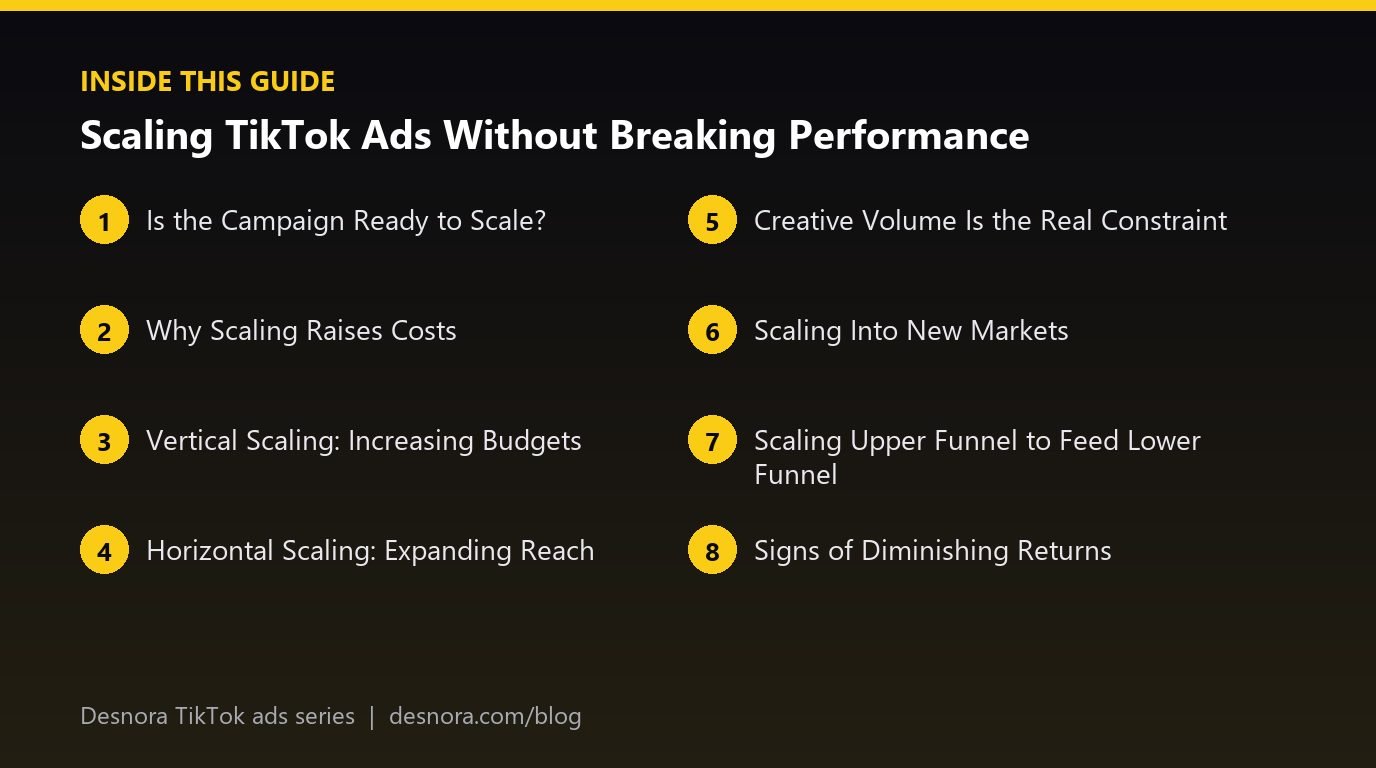
Creative Volume Is the Real Constraint
At small budgets, one strong ad can carry a campaign. At large budgets, that ad fatigues quickly and needs constant replacement. Most TikTok accounts hit a creative ceiling before they hit an audience ceiling. Scaling spend without scaling creative production is the most common reason scaling fails.
Plan production capacity before you plan budget increases. A rough rule: the more you spend, the more new ads you need each week. Our guides to creative testing and creative fatigue explain how to build that pipeline.
Scaling Into New Markets
International expansion can unlock large amounts of efficient spend, but it is a project, not a setting:
- Confirm you can ship, sell and support customers in the market.
- Localise creative properly, with native speakers and local creators rather than just subtitles.
- Set up separate campaigns per market for budget control.
- Expect a new learning period and different costs.
Our TikTok Shop guide to expanding into new countries covers the operational side.
Scaling Upper Funnel to Feed Lower Funnel
Conversion campaigns eventually exhaust the people ready to buy now. Investing in awareness and consideration campaigns grows the pool of people who know your brand, which can improve conversion campaign efficiency over time. Our full-funnel guide covers how to balance this.
Signs of Diminishing Returns
- Each budget increase produces a smaller increase in conversions.
- Frequency rises across the account even with broad targeting.
- New creative wins less often and fatigues faster.
- Blended business metrics, such as total revenue relative to total spend, stop improving even as platform results look stable.
Measure marginal returns, not just averages. If the last extra spend produced conversions at twice your average cost, you may have reached your efficient limit for now.
Measuring Scale Properly
Platform ROAS can stay stable while real incremental impact falls, especially if campaigns increasingly reach people who would have bought anyway. As you scale, watch new customer numbers, total sales and blended efficiency. Incrementality tests and lift studies help. See our guides to attribution and brand lift.
A Scaling Plan Example
- Weeks 1 to 2: confirm a stable winning ad group at target CPA. Increase budget by 20 percent every three days while CPA holds.
- Week 3: duplicate the ad group at double the budget with broad targeting. Add four new ads based on the winning concept.
- Week 4: launch a Smart+ campaign with the top ten ads as a parallel scaling engine.
- Week 5 onward: introduce a reach or video views campaign to grow the audience, and increase creative production to match spend.
Operational Readiness for Scale
Ads can scale faster than the rest of the business. Before significant budget increases, check:
- Stock: do you have inventory to meet higher demand, including best-selling variants?
- Fulfilment: can your warehouse or partner ship more orders on time?
- Customer service: can the team handle more enquiries, comments and returns?
- Cash flow: ad spend is paid before revenue arrives in some setups. Make sure higher spend does not create a cash crunch.
- Website capacity: can the site handle traffic spikes without slowing down?
Our TikTok Shop guide to inventory forecasting for viral demand covers planning stock for sudden demand.
Scaling With Creators
Creator content is one of the most effective ways to scale creative volume. Instead of relying on one in-house presenter, brands work with many creators who each bring a different audience perspective and style. Running their content as Spark Ads or licensed ads gives the scaling campaign a steady supply of native creative. Our influencer series explains usage rights and how to build a long-term ambassador programme that keeps content flowing.
Scaling and Team Capacity
More spend means more work: more creative to brief and review, more reporting and more decisions. Plan team capacity alongside budget. Many brands that scale successfully on TikTok add a dedicated creative strategist or producer before they add more media buyers.
Budget Pacing Across the Month
When scaling, think about how spend is distributed over time. Many brands see better conversion rates around paydays, weekends or specific seasonal moments. Scaling budget into those periods and easing off during weaker ones can improve overall efficiency. Use historical data from your store and ad account to identify these patterns before adjusting budgets by day or week.
Scaling Without Losing Profit
Scaling should increase profit, not just revenue. Track contribution margin after ad spend alongside ROAS. A campaign can show stable ROAS while profit falls if product costs, discounts or returns increase at higher volume. Review profit at least monthly during periods of rapid scaling, and slow down if each additional unit of spend is no longer making money.
Common Scaling Mistakes
- Tripling budgets overnight.
- Scaling on a few days of good results.
- Scaling spend without scaling creative.
- Judging scale by platform ROAS alone.
- Ignoring operational limits until stock runs out.
Frequently Asked Questions
How fast can I scale TikTok ads?
Gradual increases of around 20 to 30 percent every few days are a common safe pace. Faster scaling is possible through duplication and new campaigns, but expect more volatility.
Should I duplicate winning TikTok ad groups?
Duplication is a useful horizontal scaling method, especially at a higher budget, because it leaves the original untouched. The copy will go through learning again, so judge it over several days.
Why did my TikTok ads stop working when I increased the budget?
Larger budgets force TikTok to reach less responsive people and win more expensive auctions, and they accelerate creative fatigue. Sudden large increases can also disrupt delivery. Scale gradually and add creative.
Is horizontal or vertical scaling better on TikTok?
Most accounts use both. Vertical scaling is simpler and keeps data together. Horizontal scaling reaches new people and markets. Use vertical scaling until it shows diminishing returns, then expand horizontally.
How do I know when I have reached the limit of TikTok ads?
When each additional unit of spend produces conversions at costs above your acceptable limit, and new creative and audiences no longer change that. Measure marginal results, not just averages.
Does scaling TikTok ads require more creative?
Yes. Higher spend means ads reach more people faster and fatigue sooner. Plan creative production before increasing budget, or scaling will stall.
Should I scale into new countries on TikTok?
New markets can unlock significant growth, but only if you can sell, ship and support customers there. Localise creative properly and expect a new learning period.