Most people do not discover products on TikTok through ads. They discover them through a person they already watch, talking about something they actually use, in a voice that sounds like a friend rather than a brand. That is why influencer marketing has become one of the most reliable ways for brands to grow on the platform, and why so many brands get it wrong when they treat creators like a media slot to fill.
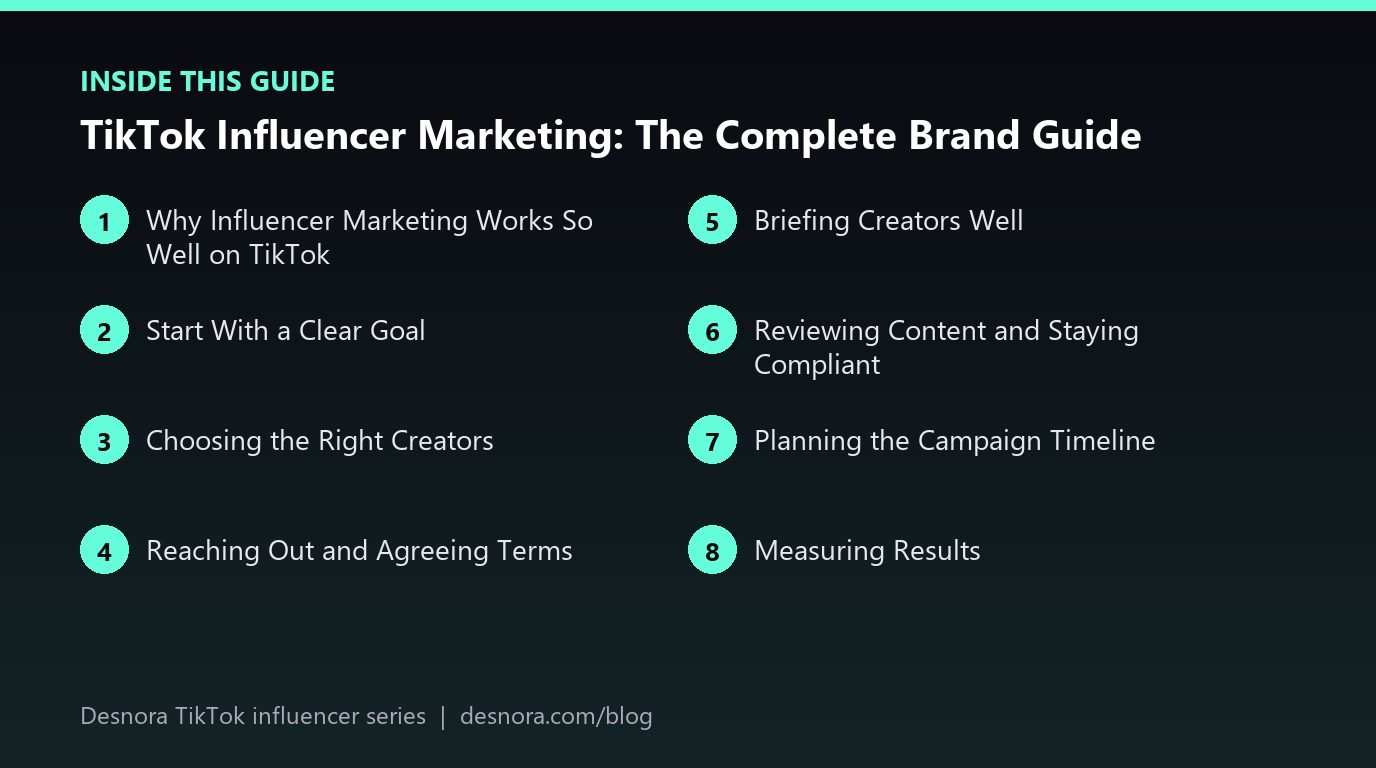
This guide is the starting point for Desnora's TikTok influencer series. It walks through the whole lifecycle of an influencer campaign, explains the decisions that matter at each stage, and points you to the deeper guide for every topic. Whether you are a small brand sending your first product to a creator or a growing business planning a year-round program, the same principles apply.

Why Influencer Marketing Works So Well on TikTok
TikTok's For You feed distributes content based on how people respond to it, not only on who follows the account. A creator with modest followers can reach hundreds of thousands of viewers if a video holds attention. That changes the economics of influencer marketing compared with older platforms, where reach was tied closely to follower count.
Three qualities make creator content particularly effective here:
- Trust. Viewers follow creators for their taste and honesty. A recommendation borrows that trust in a way a brand account cannot.
- Native format. Creator videos look like everything else in the feed, so viewers do not scroll past them the way they skip obvious ads.
- Demonstration. Short video shows a product being used, which answers buyer questions faster than text or photos.
Influencer content also feeds the rest of your marketing. Strong creator videos can be licensed for ads, reused on product pages and studied for messaging insights. Our comparison of influencers versus paid ads explains how the two work best together rather than as rivals.
Start With a Clear Goal
Every decision in an influencer campaign depends on what you want it to achieve. A campaign built for awareness picks different creators, briefs differently and measures differently from one built to drive sales this week. Before you contact a single creator, write down:
- The primary objective: awareness, consideration, sales, content creation or community building.
- The audience you need to reach, described as real people rather than demographics alone.
- The one or two metrics that will tell you whether it worked.
- The budget and the time frame.
Our guide to setting goals and KPIs covers how to match metrics to objectives and set realistic targets, and our guide to planning an influencer budget helps you size the investment.
Choosing the Right Creators
Creator selection is where campaigns are won or lost. The right creator has an audience that matches your buyer, a content style that suits your product and a track record of genuine engagement. The wrong creator can have impressive numbers and still sell nothing.
Tier and size
Creators are often grouped into tiers by follower count, from nano creators with a few thousand followers to mega creators with millions. Smaller creators usually offer stronger trust and lower costs; larger creators offer scale and cultural reach. Most brands get the best results from a mix. Our guide to influencer tiers explains the trade-offs in detail.
Audience fit
Follower count says nothing about who those followers are. Before you pay anyone, check where their audience lives, roughly how old they are, and whether the comments show the kind of people who buy products like yours. Our guide to analysing an influencer's audience walks through the checks.
Quality and authenticity
Engagement rate is a useful first filter, but it needs context. Learn how to calculate and benchmark engagement rate and how to spot fake followers and inflated engagement before you commit budget. Run brand safety checks on past content too.
If you still need to build your shortlist, our TikTok Shop guide on how to find TikTok creators who sell covers discovery methods, and our guide to niche communities helps you find the corners of TikTok where your buyers spend time.
Reaching Out and Agreeing Terms
Good creators receive a lot of brand messages. Yours needs to be personal, specific and easy to say yes to. Mention a video of theirs you genuinely liked, explain why your product fits their audience and say clearly what you are offering. Our guide to outreach messages that get replies includes templates for first contact and follow-ups.
When a creator is interested, ask for their media kit and recent analytics. Our guide to reading a creator media kit explains what to look for and what to ask when information is missing. Then agree the terms in writing: deliverables, timelines, payment, approval rounds, disclosure and usage rights. For fees and contract structure, see our TikTok Shop guide to creator contracts and rates. For how long you can reuse the content and where, see our guide to usage rights and licensing.
Briefing Creators Well
A brief should give creators everything they need to make a great video and nothing that forces them to sound like an advert. The best briefs fit on one page: the product, the audience, the one key message, a few must-say facts, the must-avoid list, and plenty of freedom on format and tone.
Creators know their audience better than you do. Tell them what you need the viewer to understand, not the exact words to say. Our guide to writing a brief creators follow includes a template, and our guide to sponsored formats that feel native helps you suggest formats that suit your product without dictating them.
Reviewing Content and Staying Compliant
Most brands review drafts before they go live, and that is reasonable. The risk is over-editing until the video loses the creator's voice. Limit feedback to factual accuracy, legal compliance and the agreed key message. Our guide to reviewing drafts without killing authenticity sets out a workflow.
Every paid or gifted partnership needs clear disclosure. In the US, the FTC expects endorsements to be disclosed clearly; in the UK, the ASA and CMA expect ads to be obviously identifiable; TikTok has its own content disclosure setting that adds a label to the video. Our guide to disclosure rules explains what applies and how to word it.
Planning the Campaign Timeline
Influencer campaigns take longer than most brands expect. Shortlisting, outreach, negotiation, shipping products, filming, approvals and posting each take time, and creators juggle many partnerships. A realistic campaign for a product launch often needs six to ten weeks from planning to posting. Our week-by-week campaign timeline shows how to schedule each step with buffers.
Events and brand trips can compress a lot of content into a short window but need even more planning. See our guide to influencer events and brand trips if that is part of your plan.
Measuring Results
Measurement starts before the campaign does. Give every creator a unique discount code or tracked link, agree which metrics they will share after posting and decide how long you will measure for. TikTok videos can keep gaining views for days or weeks, so a report written the day after posting will miss part of the effect.
Direct attribution never captures everything. Some viewers search for your brand later, buy on another channel or remember you months afterwards. Our guide to tracking influencer ROI explains how to combine direct tracking with sensible estimates of halo effects. If you sell on Amazon, our guide to sending influencer traffic to Amazon covers Amazon Attribution and listing readiness.
From Campaigns to Programs
One-off sponsored posts can work, but repeated exposure through the same trusted creators usually works better. Viewers who see a creator use a product several times believe the recommendation more than a single mention. That is why many brands move towards ongoing partnerships. Our guide to building an ambassador program explains how to structure one.
Some brands also make their founder or team members into creators. Founder-led content builds a direct relationship with the audience and gives creators a story to build on. Our guide to founder-led content covers how to start.
Special Situations
Influencer marketing looks different depending on your business. Local businesses need creators who live nearby and can bring people through the door; see our guide for local businesses. B2B companies need educational creators and longer measurement windows; see our guide to B2B influencer marketing. Brands selling in several countries need local creators and local rules; see our guide to international campaigns.
Some brands are also experimenting with virtual and AI influencers, which bring their own trust and disclosure questions. And every brand should be ready for the day a creator does not like the product.
Tools and Team
A handful of creators can be managed in a spreadsheet. Once you work with dozens, you need a way to track conversations, contracts, product shipments, deliverables, payments and results. Our comparison of influencer marketing tools explains which categories of software help and when they are worth paying for. Our guide to common influencer marketing mistakes is a useful checklist before you scale.
A Simple First Campaign Plan
- Define one goal, one audience and one or two success metrics.
- Set a budget that includes fees, product, shipping and a small amplification fund.
- Build a shortlist of 20 to 40 creators who already talk to your buyers.
- Check audience fit, engagement quality and brand safety for each.
- Send personal outreach to your top choices and follow up once.
- Agree terms in writing, including disclosure and usage rights.
- Send a one-page brief and the product with enough time to try it properly.
- Review drafts for accuracy and compliance only.
- Track every creator with a unique code or link.
- Report results after two to four weeks and re-book the creators who performed.
Influencer marketing rewards brands that treat creators as partners and measure patiently. If you would like help planning creator campaigns, preparing your listings and content for the traffic they bring, or building a TikTok Shop that converts, explore Desnora's TikTok Shop services or contact us.
Frequently Asked Questions
What is TikTok influencer marketing?
It is a partnership between a brand and a TikTok creator, where the creator features the brand's product or service in their content in exchange for payment, free product, commission or a combination.
How much does TikTok influencer marketing cost?
It ranges from free product for small creators to large fees for well-known names. Costs depend on audience size, engagement, deliverables, usage rights and exclusivity. Plan your budget around goals rather than a fixed price per creator.
Do I need a TikTok Shop to work with influencers?
No. Creators can send viewers to your website, Amazon listing or physical store. A TikTok Shop makes it easier for viewers to buy without leaving the app and enables affiliate commissions.
How many influencers should I work with for a first campaign?
Many brands start with five to fifteen creators. That is enough to compare performance and learn what works without spreading the budget too thinly.
Are smaller influencers worth it?
Often, yes. Smaller creators tend to have closer relationships with their audiences, lower costs and higher engagement. A group of them can outperform a single large creator for many products.
Do influencer posts need to be labelled as ads?
Yes. Paid or gifted partnerships need clear disclosure under advertising rules in most markets, and TikTok expects creators to use its content disclosure setting for branded content.
How do I measure whether an influencer campaign worked?
Use unique codes or tracked links for direct sales, compare against your goal metrics, and watch for indirect effects such as branded search and sales on other channels over the following weeks.
Should I tell creators exactly what to say?
No. Give them the key message, important facts and things to avoid, then let them present it in their own style. Scripted videos usually perform worse.
How long does an influencer campaign take to run?
From planning to the last post, many campaigns take six to ten weeks. Product launches and large campaigns often need longer.
Can I reuse influencer videos in my ads?
Only if your agreement includes usage rights for paid advertising. Agree the scope and duration in writing before the content is made.