A campaign that works brilliantly in the UK will not automatically work in Germany, Spain or the US. Humour, values, shopping habits, advertising rules and even the most popular TikTok formats vary by country. Brands expanding internationally often assume they can copy their home campaign, translate the brief and hire creators abroad. The results are usually disappointing.
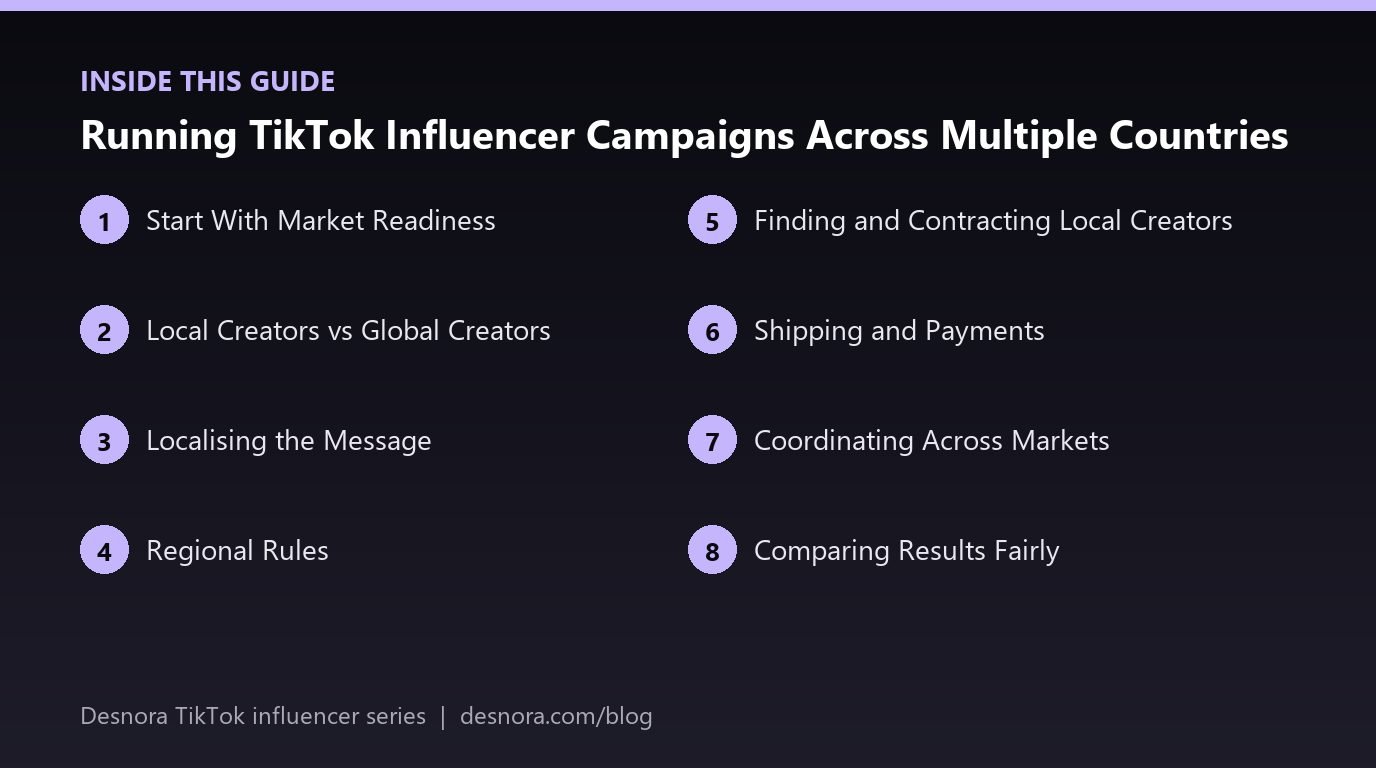
This guide explains how to plan TikTok influencer campaigns across multiple countries: choosing local or global creators, localising messages, handling regional rules, managing shipping and payments, coordinating teams and comparing results fairly between markets.

Start With Market Readiness
Before recruiting creators in a new country, check that you can actually serve customers there:
- Can customers buy easily, through a local TikTok Shop, a local website or a marketplace?
- Is delivery fast and affordable, with clear returns?
- Are prices shown in local currency and competitive?
- Is customer service available in the local language?
- Does the product meet local labelling and regulatory requirements?
TikTok Shop is available in a limited set of countries, and availability changes. Our TikTok Shop guide to international expansion covers the operational side.
Local Creators vs Global Creators
Local creators
Creators based in each country, speaking the local language to a local audience. They understand local humour, culture and shopping habits, and their followers can buy from local channels.
Best for: most product campaigns, especially sales-focused ones.
Global creators
Creators with large international audiences, often posting in English or with little speech. They can reach several countries at once.
Best for: awareness, visual products and launches where reach matters more than local conversion.
Check global creators' audience splits carefully. A creator described as international may have most followers in one country. Our guide to audience analysis explains how to check location data.
Most brands get the best results by building a core of local creators in each priority market, with occasional global creators for big moments.
Localising the Message
Translation is not enough. Localisation means adapting the message to what matters in each market:
- Benefits: buyers in different countries may care about different things, such as price, sustainability, durability or design.
- Proof: some markets respond more to expert endorsement, others to peer reviews or certifications.
- Tone: humour, directness and formality vary. A brief that encourages cheeky humour may not suit every market.
- Seasonality: holidays, sales events and seasons differ. Our TikTok Shop guide to the seasonal sales calendar helps plan around local moments.
Ask local team members, agencies or creators to review the brief before it goes out. Our guide to writing a brief explains the structure; keep it the same across markets, but localise the content.
Regional Rules
Advertising and disclosure rules differ between countries. Examples include:
- United States: FTC guidance expects clear disclosure of material connections.
- United Kingdom: the ASA and CMA expect ads to be obviously identifiable, typically with "Ad" labels upfront.
- European Union: EU consumer law prohibits hidden advertising, and individual countries add their own rules. France, for example, has specific influencer legislation covering disclosure and restricted product categories.
- Other markets: many countries have their own codes, with local-language disclosure requirements.
Product rules also vary. Claims allowed in one country may be prohibited in another, especially for cosmetics, supplements, food and children's products. Our guide to disclosure rules covers the main markets. For new markets, take local advice before launch.
Finding and Contracting Local Creators
Finding creators abroad is harder when you do not speak the language or know the local creator scene. Options include:
- TikTok's creator tools, which can filter by country. See our TikTok Shop guide to the Creator Marketplace.
- Local agencies or freelancers who know the market. Our TikTok Shop guide to creator agencies explains how to choose one.
- Asking your existing creators for recommendations.
- Searching TikTok in the local language for your category and problems.
Contracts should reflect local law, currency and payment norms. Outreach in the creator's own language gets far better responses than English messages.
Shipping and Payments
International campaigns add practical complexity:
- Shipping: cross-border parcels can take longer and face customs charges. Ship from local stock where possible, or send early with duties prepaid so creators are not charged.
- Restricted products: some products cannot be shipped to certain countries or require special handling.
- Payments: pay creators in local currency, with clear invoicing and tax documentation. Payment platforms can simplify this.
- Tax: check whether withholding tax or reporting obligations apply when paying foreign creators.
Our campaign timeline recommends adding time for international shipping and approvals.
Coordinating Across Markets
Running several countries at once requires clear coordination:
- Use one central plan with shared goals and KPIs, and local plans for creators, messaging and timing.
- Assign a local owner in each market, whether a team member or agency.
- Keep a central tracker of all creators, stages, costs and results.
- Share learnings across markets regularly. A format that works in Spain might work in Italy.
- Stagger launches if resources are limited, starting with the most promising market.
Comparing Results Fairly
Markets differ in creator costs, audience size, conversion rates and average order values. Compare markets using cost per result, such as cost per acquisition or cost per thousand relevant views, rather than raw totals. Convert currencies consistently and account for differences in shipping and fulfilment costs. Our guide to tracking ROI explains the calculations.
Expect new markets to perform below established ones at first, while brand awareness builds. Give them enough time and budget to learn before judging.
Language, Captions and Accessibility
Language choices affect reach within each market. Creators should speak and caption in the language their audience uses, even if the brand's home language is different. Avoid asking local creators to use English slogans or product descriptions unless that is common in their market. Where your brand name or product names are hard to pronounce, give creators a simple pronunciation guide and accept local variations.
On-screen captions help in every market, since many people watch without sound. Ask creators to include captions in the local language, and avoid text on screen that only makes sense in translation. If your product pages, packaging or customer service are not yet available in the local language, fix that before inviting creators to send viewers there, or the traffic will leak away at the final step.
Common International Mistakes
- Copying a home-market campaign without localising benefits or tone.
- Using creators whose audiences are mostly outside the target country.
- Sending English briefs and outreach to creators in other languages.
- Forgetting customs charges, leaving creators to pay to receive gifts.
- Judging a new market against an established one too early.
A Worked Example
A UK sustainable activewear brand expanded to Germany and the Netherlands. Its first attempt used English-speaking global fitness creators and a translated UK brief. Views were high, but sales in the new markets were low; most viewers were in the UK and US.
The second attempt used ten local creators in each country, contacted in their own language through a local freelancer. The brief was adapted: German creators emphasised durability and certifications, which local buyers valued highly, while Dutch creators focused on cycling and everyday wear. Disclosure followed local guidance in each language. Products were shipped from a European warehouse to avoid customs delays. Cost per acquisition in both countries came within reach of the UK figure by the third campaign.
International Campaign Checklist
- Confirm each market is ready for customers.
- Prioritise local creators for sales goals.
- Localise benefits, proof, tone and timing, not just language.
- Check disclosure and product rules for each country.
- Contact creators in their own language.
- Plan shipping, customs, payments and tax.
- Coordinate with central goals and local owners.
- Compare markets using cost per result.
International influencer campaigns reward careful localisation. If you would like help expanding your TikTok Shop and creator campaigns into new markets, explore Desnora's TikTok Shop services or contact us.
Frequently Asked Questions
Should I use local or global creators for international campaigns?
Local creators usually perform better for sales, because their audiences can buy locally. Global creators can help with awareness.
Is translating my brief enough?
No. Localise benefits, proof, tone and timing for each market, and have local experts review the brief.
Do disclosure rules differ by country?
Yes. The US, UK, EU and other markets have different guidance, and labels should usually be in the local language.
How do I find creators in other countries?
Use TikTok's creator tools, local agencies or freelancers, recommendations and searches in the local language.
How should I ship products to international creators?
Ship from local stock where possible, or send early with duties prepaid so creators are not charged customs fees.
How do I compare results between countries?
Use cost per result, such as cost per acquisition, with consistent currency conversion, rather than raw totals.
Should I launch in several countries at once?
Only if you have the resources. Many brands start with one or two priority markets and expand based on results.
Do I need a local team in each country?
A local owner, whether a team member, freelancer or agency, makes coordination, outreach and localisation much easier.