Running a TikTok Shop involves a huge amount of repetitive work: brainstorming hooks, writing captions, drafting creator briefs, editing videos, writing product descriptions, answering messages and analysing reports. AI tools can speed up much of this, freeing time for the work that needs human creativity and judgement. Used carelessly, they can also produce generic content, factual errors and compliance problems.
This guide explains practical, responsible ways to use AI in a TikTok Shop business, where it helps most and where you should keep humans firmly in control. Tool names change quickly, so we focus on use cases rather than specific products.

Where AI Helps Most
- Ideation: generating hook ideas, content angles and series concepts.
- Drafting: first drafts of scripts, captions, briefs and listings.
- Editing: auto-captions, cutting silences, resizing and background noise reduction.
- Translation and localisation: first drafts for new markets.
- Customer service: drafting replies and summarising conversations.
- Analysis: summarising comments and reviews, spotting patterns in data.
AI for Content Ideation
AI chat tools are useful brainstorming partners. Give them context about your product, audience and best-performing videos, and ask for hook variations, angles or series ideas. Treat the output as raw material: pick the strongest ideas, adapt them to your brand voice and test them. Our guide to hooks explains what makes openings work, which helps you judge AI suggestions.
AI for Scripts and Briefs
AI can draft script outlines and creator briefs quickly. Provide the framework you want, such as problem, demonstration, proof and call to action, along with your claims guide. Always review drafts for accuracy and compliance before sharing. Our guides to video scripts and the affiliate program cover what good briefs include.
AI in Video Editing
Editing apps increasingly include AI features: automatic captions, silence removal, background noise reduction, smart reframing and template suggestions. These save significant time, especially for brands producing content daily. Always check auto-captions for errors in product names and numbers. Our video editing guide explains editing fundamentals.
AI for Listings
AI can draft product titles, descriptions and bullet points from your specifications. Provide accurate product data and keyword research, then edit the output carefully. AI tools can invent features, exaggerate benefits or use prohibited words if not checked. Our listing optimization guide and search SEO guide explain what listings need.
AI for Translation
When expanding to new markets, AI translation provides a fast first draft for listings, briefs and support templates. Have native speakers review everything customer-facing, because tone, idioms and local terms matter, and errors can create compliance issues. Our international expansion guide covers localisation.
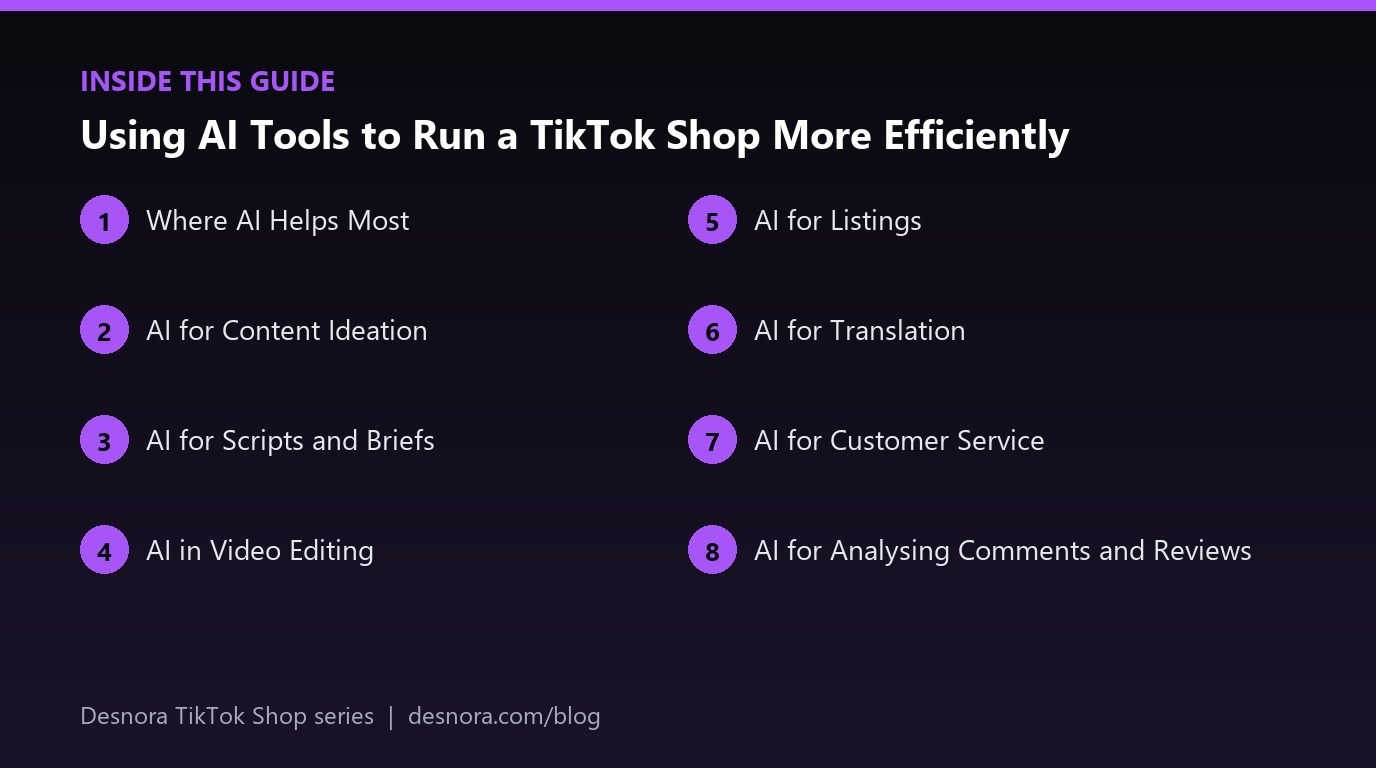
AI for Customer Service
AI can draft replies to common questions, summarise long conversations and suggest templates. Keep a human in the loop for sending, especially for complaints, safety issues and anything involving refunds or policy decisions. Make sure drafts reflect your actual policies. Our customer service templates provide a reliable base.
AI for Analysing Comments and Reviews
Summarising hundreds of comments or reviews by hand is slow. AI can group feedback into themes such as sizing, quality, delivery and praise, helping you spot patterns quickly. Use these insights to improve listings, products and content. Verify important findings by reading samples yourself. Our reviews guide explains how to act on feedback.
AI for Data Analysis
AI tools can help summarise exported reports, build spreadsheet formulas and highlight trends. They are useful for speed, but double-check calculations and conclusions, especially those that drive spending decisions. Our analytics guide explains the metrics to focus on.
AI-Generated Visuals and Avatars
AI can generate images and even synthetic presenters. On TikTok, authenticity matters, and platforms may require labelling of AI-generated content in certain cases. AI visuals can help with concept mock-ups or backgrounds, but product images must represent the real product accurately. Avoid using AI-generated people to imply real customer testimonials, which is misleading. Check TikTok's current rules on AI-generated content before using it.
Risks and Guardrails
- Accuracy: AI can state false facts confidently. Verify product details and claims.
- Compliance: AI may suggest prohibited claims. Review everything against your claims guide.
- Generic content: AI-only content often sounds bland. Add personality and real experience.
- Privacy: avoid pasting customer personal data into tools without appropriate safeguards and policies.
- Disclosure: follow platform rules on labelling AI-generated content.
- Intellectual property: be careful with AI outputs that may resemble others' work.
Our account health guide explains why compliance checks matter.
Building an AI-Assisted Workflow
- Identify repetitive tasks that consume the most time.
- Test AI tools on those tasks with clear prompts and examples.
- Create prompt templates that include brand voice and compliance rules.
- Keep humans responsible for final review and sending.
- Measure time saved and quality, and adjust.
What AI Cannot Replace
AI cannot replace genuine product experience, authentic creator relationships, real demonstrations or human judgement about your brand and customers. The best-performing TikTok content still comes from real people showing real products. Use AI to clear the busywork so your team has more time for the creative, relationship-driven work that actually wins on TikTok.
Writing Better Prompts
AI output quality depends heavily on the instructions you give. Include context about your brand, product, audience and goal; give examples of content you like; specify the format and length; and list constraints such as banned claims or required disclosures. Ask for several options rather than one. Save prompts that work well as templates so your team gets consistent results. Small improvements to prompts often produce much more useful drafts.
AI for Planning and Organisation
Beyond content, AI can help with planning: drafting content calendars, summarising meeting notes, creating checklists for launches and turning rough ideas into structured plans. These uses save time without the risks of customer-facing content. Combine them with your own calendar and project tools, as described in our content calendar guide.
Keeping Your Brand Voice
AI tools tend to produce similar-sounding text, which can make brands blend together. Protect your voice with a short style guide covering tone, favourite phrases, words to avoid and examples. Include it in prompts and edit drafts to add real experiences, specific details and personality. Audiences on TikTok respond to authenticity, so the human touch remains essential.
Team Policies for AI Use
As more people on your team use AI, agree simple rules: which tools are approved, what data can be shared, what must always be reviewed and who is responsible for final approval. Clear policies protect customer privacy, reduce compliance risk and keep quality consistent across the team.
Measuring the Value of AI
Track whether AI actually helps. Measure time spent on tasks before and after, the number of videos or listings produced and whether quality metrics such as retention, conversion and customer satisfaction hold up. If AI saves time but content performance drops, adjust how you use it. The goal is better results with less busywork, not simply more output.
Common Mistakes
- Publishing AI drafts without review.
- Letting AI invent product features or claims.
- Replacing authentic creators with synthetic content.
- Sharing customer data carelessly.
- Ignoring AI labelling rules.
Desnora uses modern tools alongside experienced specialists to produce TikTok Shop content efficiently. Explore our TikTok Shop services or talk to us.
Frequently Asked Questions
Can AI write TikTok Shop video scripts?
AI can draft outlines and hook ideas quickly, but review for accuracy, compliance and brand voice, and let creators deliver them naturally.
Is it safe to use AI for product listings?
Yes, as a first draft. Provide accurate data and check the output carefully, since AI can invent features or use prohibited words.
Can AI answer customer messages for me?
AI can draft replies, but keep a human responsible for sending, especially for complaints, refunds and safety issues.
Do I need to label AI-generated content on TikTok?
Platform rules may require labelling of certain AI-generated content. Check TikTok's current policies.
Can I use AI-generated images for products?
Product images must represent the real product accurately. AI visuals may help with concepts or backgrounds, not misleading depictions.
How can AI help analyse reviews?
AI can group comments and reviews into themes, helping you spot patterns in sizing, quality, delivery and praise faster.
Will AI replace TikTok creators?
Authentic human creators and real demonstrations remain central to TikTok. AI is best used to support, not replace, them.
What are the main risks of using AI?
Inaccuracy, non-compliant claims, generic content, privacy issues, missing disclosures and potential intellectual property concerns.
Can AI translate listings for new markets?
It provides a fast first draft, but native speakers should review customer-facing text for tone, local terms and compliance.
How should a small team start with AI?
Pick the most time-consuming repetitive tasks, test tools with clear prompts, build prompt templates and keep human review in place.
How do I write better AI prompts for TikTok Shop?
Include brand, product, audience and goal context, give examples, specify format and constraints such as banned claims, and ask for several options.
How do I know if AI is helping my TikTok Shop?
Compare time spent and output before and after, and check that retention, conversion and customer satisfaction stay strong.
Should my team have rules for using AI?
Yes. Agree approved tools, what data can be shared, what must be reviewed and who gives final approval.